
 Talk to sales
LLM Visibility for Beauty Product Pages (GEO & SEO)
Granular data for better LLM Visibility
When a shopper asks ChatGPT, Claude, Perplexity, or Google’s AI Overviews “what’s a good fragrance-free moisturizer for sensitive skin,” the AI doesn’t invent the answer; it pulls from product pages it has crawled and parsed.
The richer and more structured your PDP, the more likely your product is the one the AI recommends, names, and links to. Inference Beauty enriches your product pages with this granular, structured data automatically — turning catalog pages AI can barely read into the answers it gives shoppers.
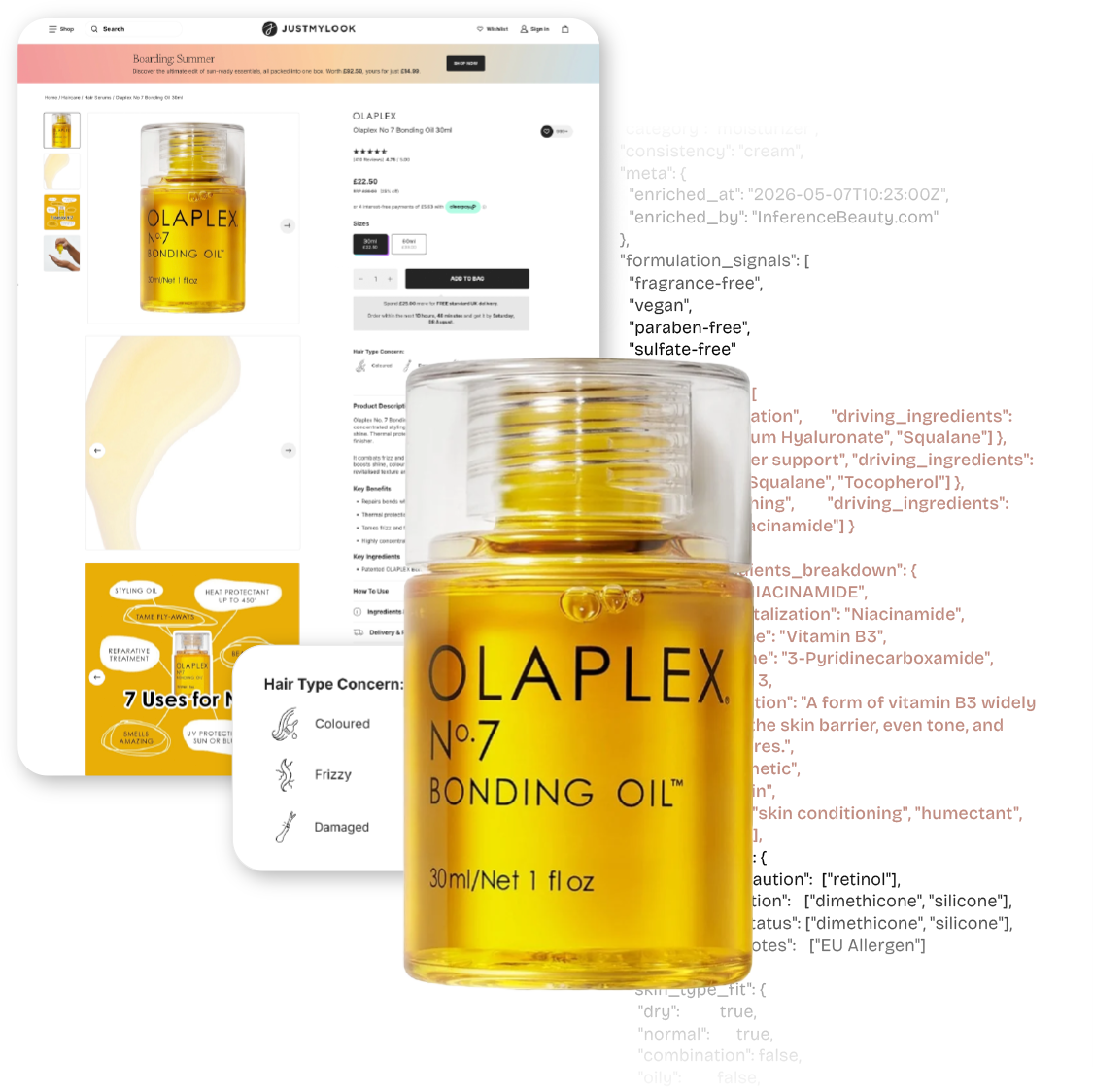

Beauty discovery is moving to AI. Your PDPs aren’t ready.
The questions shoppers used to type into Google — “best fragrance-free moisturizer for sensitive skin,” “is this safe during pregnancy,” “what does niacinamide do” — are now going to AI. And AI answers by reading the most structured, factual product data it can crawl.
Marketing copy is too vague. INCI lists are illegible to consumers and to AI alike. Reviews are subjective and live on third-party domains. The brands that win the next era of discovery are the ones whose product pages are built to be cited.
What we can provide that LLMs hunger for:
- Natural-language ingredient descriptions (50–150 words each)
- Canonical naming + aliases — so semantic queries (“vitamin B3” → niacinamide)
- Property/utility taxonomy — so concern queries (“anti-aging,” “non-comedogenic”)
- Free-from and concern flags — so exclusion queries (“paraben-free,” “fragrance-free”)
- Source/derivation — vegan, animal-derived, synthetic, mineral. Increasingly queried
- Use-case framing — “good for X / avoid if Y.” Mirrors user query patterns directly — benefit list
Features
From INCI list to structured product intelligence.
We own one of the most complete verified ingredient databases in beauty. For every ingredient we publish common names, plain-English descriptions, functional properties, allergen and safety flags, source and derivation, regulatory notes, and popularity signals.
From your product’s INCI list we then synthesise a product-level intelligence layer: a clean 100-word summary, formulation signals (fragrance-free, vegan, pregnancy-safe, non-comedogenic), skin-type fit, concern targeting, and key benefits traced back to their driving ingredients.
It all arrives in a single JSON payload, keyed by EAN, designed to drop straight into your PDP as JSON-LD plus a visible ingredient component.
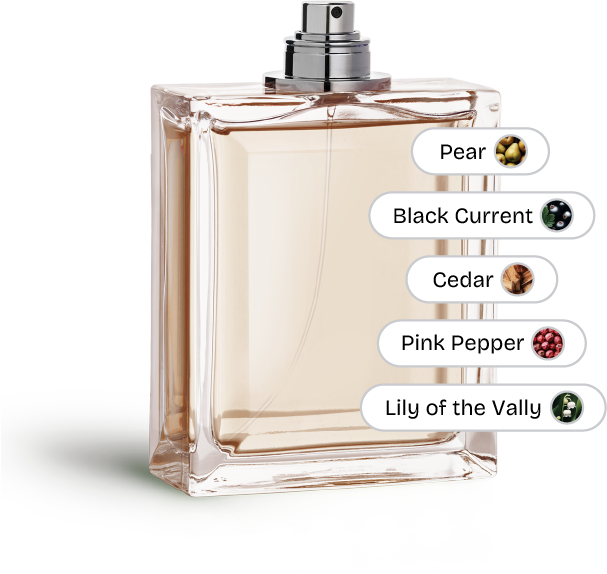
Fragrance Data
Olfactory-Family, Fragrance Notes, Style, Occasion, and Season
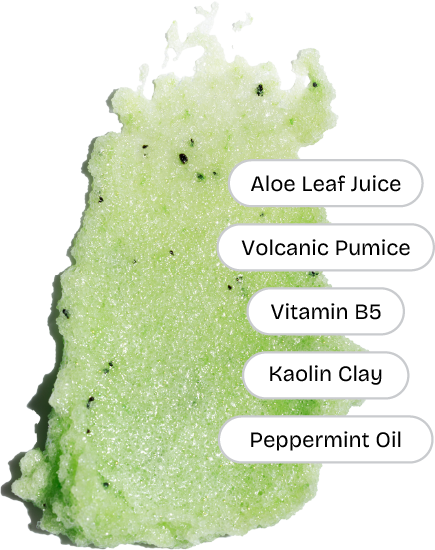
Ingredient Data
Full INCI Lists including enrichment with descriptions and key benefits
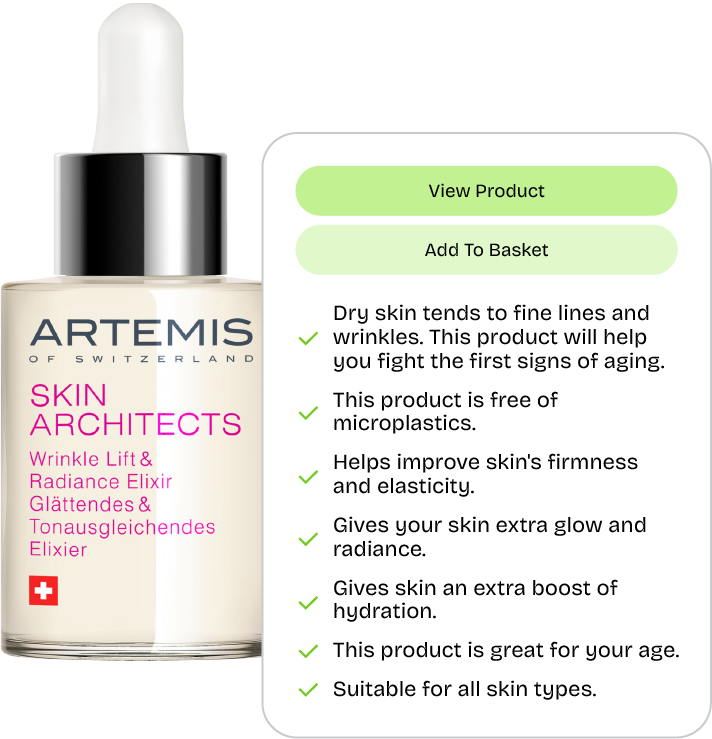
Product Highlights
Synthesised summary for formulation signals, skin-type fit, and concern targeting
A single API call. Everything an AI needs to recommend your product.
One endpoint returns a structured object containing a product-level rollup (Natural-language ingredient descriptions, utility, alternative names, free-from flags, concern flags, source, use case framing, best-fit, consistency and more)
That structure becomes the JSON-LD that an AI parses, plus the source for a clean, visible ingredient-transparency module on your PDP — the kind shoppers see and AI crawlers read in tandem.
Three steps to a citation-grade PDP (Product Detail Page)
- API key provisioned. We onboard you and ingest your inventory via a product feed. EANs in your catalog are matched to our database.
- Your team integrates. Server-side fetch on each PDP request. We ship a working Node.js reference template — typically half a day of engineering work per stack.
- Your PDPs go live. JSON-LD enters the page head, a visible ingredient module renders in the body, and robots.txt welcomes the LLM crawlers.

Product Features
Made for Beauty Retail
We cover your Retail Inventory
With over 110 beauty categories and over 100,000 products in our database, we’ve got your products covered so that you never have to source this filter data again.
To keep up with your inventory we will do rolling inventory updates based on a dedicated product feed.
Why an enriched JSON endpoint is the right primitive
Normalized and predictable. LLMs perform better on structured data with consistent vocabulary than on bespoke marketing copy.
Server-side renderable. Most LLM crawlers (GPTBot, ClaudeBot, PerplexityBot, OAI-SearchBot) do not reliably execute JavaScript. The endpoint output must be served into the HTML at request time, not hydrated client-side.
Schema.org alignable. Wrapping the payload in JSON-LD with @type: Product plus our extended ingredient vocabulary maps directly to the structured-data conventions LLMs and search engines already understand.
Cacheable. ETag + CDN means low-latency rendering at scale.
Brand-owned. The brand controls the distribution surface (their own PDP). No dependency on third-party aggregators.
Sources behind our database
Our beauty product database is a comprehensive collection of product information sourced directly from beauty brands. These brands either provide us with specific data feeds, which are like digital catalogs containing detailed product information, or we extract relevant data from their public websites. This ensures that our database is always up-to-date and reflects the latest product offerings and brand information.
Our ingredient database is a reliable source of information on the safety and sustainability of cosmetic ingredients. We meticulously gather data from trusted organizations such as Beat the Microbead, The Responsible Mica Initiative (RMI), RSPO, COSING, the Scientific Committee on Consumer Safety, the World Health Organization (WHO), Cosmetics Europe, the Cosmetics Ingredient Review (CIR), and the U.S. Food and Drug Administration. By combining these authoritative sources, we ensure that our ingredient database provides up-to-date information to help consumers make informed choices.
What we publish that LLMs hunger for
The flag taxonomy (anti-aging, comedogenic, allergen, etc.) is necessary but not sufficient. LLMs ingest and synthesize text — natural-language descriptions matter more than booleans alone. Our enrichment combines both:
Use-case framing — “good for X / avoid if Y.” Mirrors user query patterns directly
Natural-language ingredient descriptions (50–150 words each)
Canonical naming + aliases — so semantic queries (“vitamin B3” → niacinamide)
Property/utility taxonomy — so concern queries (“anti-aging,” “non-comedogenic”)
Free-from and concern flags — so exclusion queries (“paraben-free,” “fragrance-free”)
Source/derivation — vegan, animal-derived, synthetic, mineral. Increasingly queried
Data prerequisites
What you need to have on hand about your products:
Product category (moisturizer, serum, sunscreen, etc.). Optional but useful.
EAN-13 barcodes for every product you want enriched. This is the canonical lookup key — without it we can’t match against our database.
INCI list per product. If we already have your catalog indexed, you don’t need to supply it. If not, we’ll ask you to send the INCI strings during onboarding.
Commercial metadata — product name, brand, image URL, canonical product URL, price + currency. You almost certainly already have this in your PIM, Shopify, or commerce backend. If you’re missing any of these fields, we can usually fill them in from our own product database.
Technical prerequisites
What your stack needs to support:
robots.txt control so you can welcome the LLM crawlers (GPTBot, ClaudeBot, PerplexityBot, OAI-SearchBot, Google-Extended).
Server-side rendering of product detail pages. The data must be fetched from your server (not the browser) and injected into the HTML at response time. SSR or pre-rendering is required.
Compatible stacks include Next.js, Nuxt, Remix, Astro, Shopify, WooCommerce, Magento, and most custom server stacks. Not compatible without changes: pure CSR-only SPAs (Vite/React without SSR, classic Angular SPAs).
Ability to call an external HTTPS API server-side, with Bearer token auth.
A caching layer — Redis, memcached, in-process, or the framework’s native cache (Next.js ISR, Shopify metafields, WordPress transients). Light requirement; most stacks have one.
Template access to inject content into both <head> (for the JSON-LD block) and <body> (for the visible ingredient module).