 Talk to sales
Why AI Doesn’t Recommend Your Beauty Products and How GEO Can Fix It
Product category
Author

For years, beauty brands focused on optimizing product pages for traditional search engines. Today, product discovery is increasingly happening through AI-powered platforms that generate recommendations, compare products, and surface relevant options based on shopper intent.
When consumers look for foundations suited to mature skin, fragrance-free skincare products, or alternatives to premium beauty brands, AI engines often provide direct recommendations instead of a list of search results. The challenge is that many beauty products never appear in these recommendations because AI systems cannot easily understand or interpret the information available on their product pages.
This is where Generative Engine Optimization (GEO) becomes critical.
Understanding how generative engine optimization works can help beauty brands improve their visibility in AI-powered search experiences and ensure their products are included when shoppers ask for recommendations.
What Happens When a Shopper Asks AI for a Beauty Recommendation
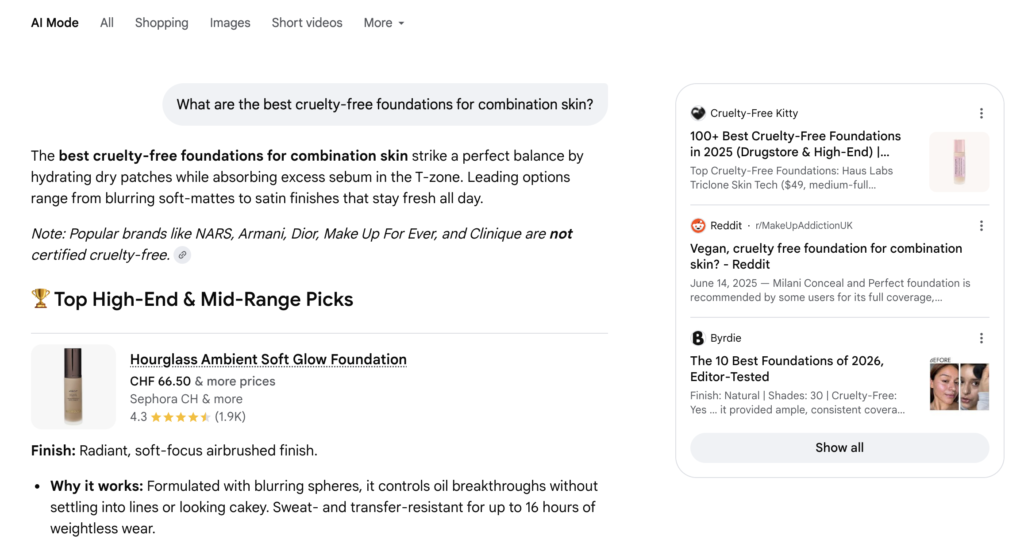
When a shopper asks an AI platform for a beauty recommendation, the process looks very different from traditional search.
Instead of matching keywords and displaying webpages, large language models (LLMs) analyze available information, identify relevant products, compare attributes, and generate a curated response.
For example, a shopper may ask:
“What are the best cruelty-free foundations for combination skin?”
The AI engine attempts to identify products that meet specific criteria, such as:
- Skin type compatibility
- Coverage level
- Ingredient profile
- Finish and texture
- Brand positioning
- Customer sentiment
- Product availability
Products that contain structured, machine-readable information are significantly easier for AI systems to understand and recommend.
Products with fragmented, inconsistent, or incomplete information are often overlooked.
As AI-assisted shopping grows, visibility depends not only on what brands publish but also on how AI systems interpret that information.
Why Most Beauty Product Pages Are Invisible to AI
Many beauty brands invest heavily in creating compelling product pages, but AI systems evaluate product information differently than human shoppers. While a page may be visually appealing and conversion-focused, it may still lack the signals AI engines need to understand and recommend a product.
Common reasons beauty product pages struggle with AI visibility include:
- Product information is buried in marketing copy. Key details about ingredients, benefits, and use cases are often embedded within promotional language rather than presented in a clear, structured format.
- Important attributes are difficult for AI to identify. Information such as skin type compatibility, finish, coverage level, certifications, and ingredient benefits may not be explicitly defined.
- Product data lacks consistency. Different products may describe similar attributes using different terminology, making it harder for AI systems to compare and categorize them accurately.
- Visual content contains critical information. Shade comparisons, ingredient highlights, and product benefits are frequently displayed in images or graphics that AI engines may not fully interpret.
- Pages are optimized for shoppers, not machine understanding. Content is often written to persuade customers rather than help AI systems understand who the product is for and when it should be recommended.
What Is GEO (Generative Engine Optimization)?
Generative Engine Optimization (GEO) is the practice of optimizing content and data so that AI-powered search engines and large language models (LLMs) can easily understand, interpret, and reference it in their responses.
Unlike traditional SEO, which focuses on improving rankings in search engine results pages, GEO focuses on improving visibility within AI-generated answers and recommendations. The goal is to ensure that AI systems can accurately identify your products, understand their attributes, and surface them when users ask relevant questions.
For beauty brands, this means making product information more accessible and machine-readable. AI engines need clear signals about ingredients, skin concerns, shade ranges, product benefits, certifications, and use cases in order to determine when a product is relevant to a shopper’s query.
How GEO Helps Beauty Brands
As AI-powered search and discovery tools become more common, GEO helps beauty brands make their product information easier for AI systems to understand, interpret, and reference.
Here’s how generative engine optimization works for beauty brands:
1. Greater AI Visibility
Makes product information more accessible to AI systems, helping them identify relevant products when processing beauty-related queries.
2. Higher Brand Authority
Supports consistent and comprehensive product information across digital channels, making it easier for AI systems to understand your brand and product portfolio.
3. Improved Product Discovery
Helps AI systems better interpret product attributes such as ingredients, formulations, skin concerns, certifications, and shade ranges.
4. More Qualified Traffic
Improves the discoverability of product information for consumers using AI-assisted search and research tools during the buying process.
5. Increased Consumer Trust
Helps ensure that product details, ingredients, and claims are communicated clearly and consistently across AI-powered experiences.
6. Stronger Competitive Advantage
Allows brands to prepare for emerging AI-driven discovery channels while many competitors remain focused solely on traditional search optimization.
How Inference Beauty’s LLM Visibility Tool Supports GEO
Many beauty brands recognize the importance of AI visibility but struggle to operationalize it across hundreds or thousands of SKUs.
Manual optimization is often difficult to scale.
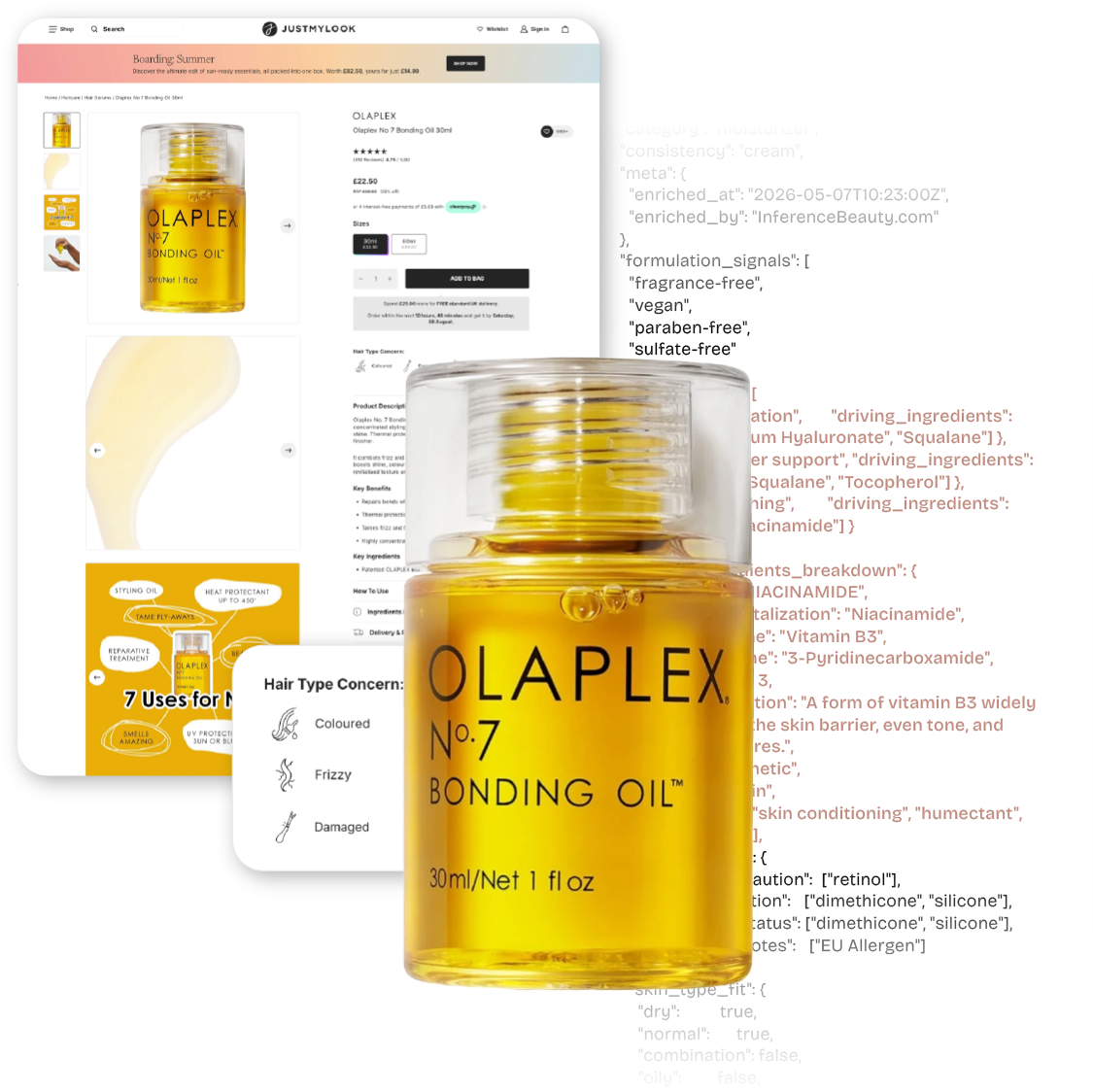
Inference Beauty’s LLM Visibility solution is designed specifically to help beauty brands improve discoverability across AI-powered search platforms.
| What Most PDPs Contain | What Inference Beauty Adds |
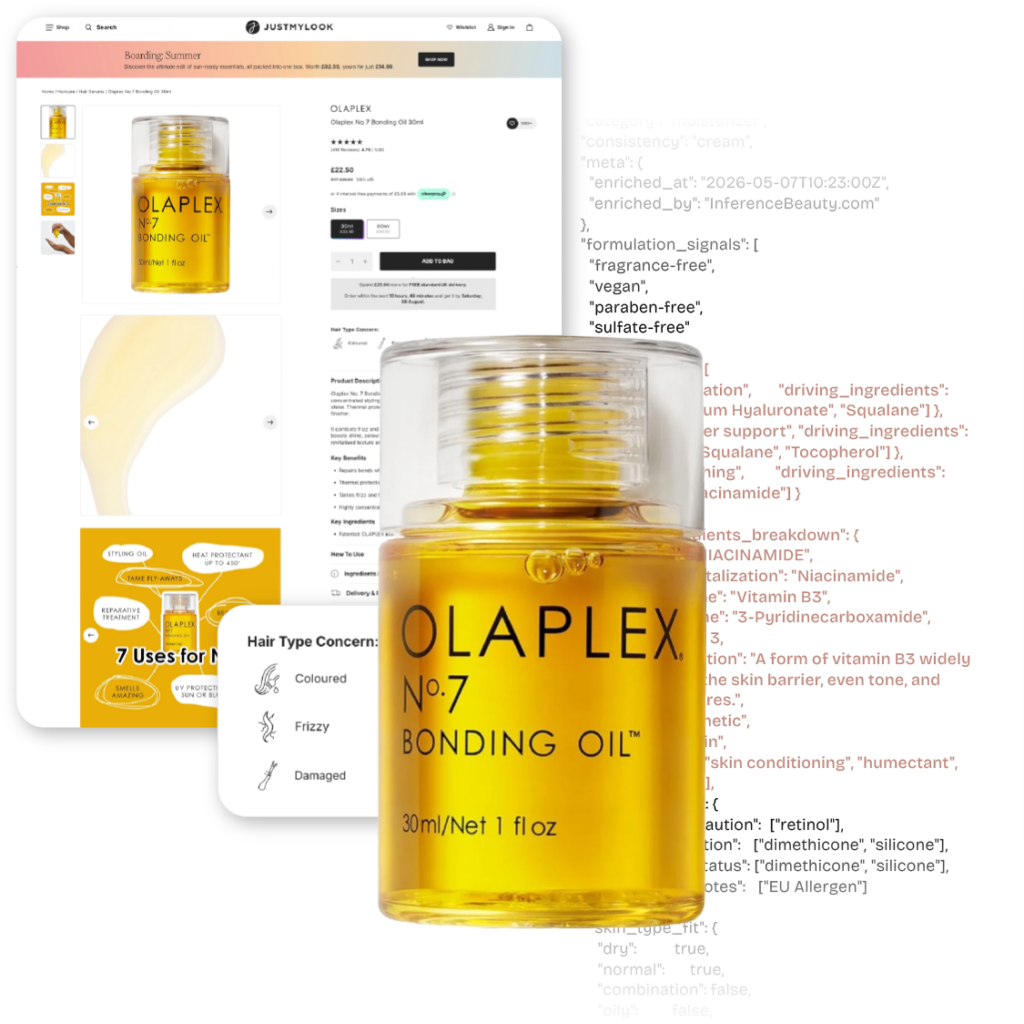
| ingredient lists | Properly formatted INCI (International Nomenclature of Cosmetic Ingredients) An ingredient list uses basic marketing or common names, often varying by country. A properly formatted INCI (International Nomenclature of Cosmetic Ingredients) list is a globally standardized, legally required system. |
| INCI Only | Common names and ingredient aliases. (e.g., instead of Butyrospermum Parkii Butter, our solution also shows the common name Shea butter and explains its function; a moisturizing ingredient that helps nourish and soften dry skin.) |
| Product claims | Ingredient-backed benefit explanations. (e.g., instead of simply “Brightening serum,” our tool adds context such as Contains Vitamin C to help reduce the appearance of dark spots and Niacinamide to promote a more even-looking skin tone.) |
| Basic product description | Skin-type and concern targeting. (e.g., our solution adds: Suitable for oily and combination skin. Helps address excess oil, enlarged pores, and acne-prone skin. Additional concern flags, such as good to use for sensitive skin, pregnancy safe, etc.) |
| Limited formulation information | Fragrance-free, vegan, non-comedogenic, and other formulation signals. |
| Generic descriptions | Use-case guidance and product suitability context (e.g., best for oily skin types, designed for acne-prone skin, suitable for sensitive skin) |
| Unstructured content | AI-readable structured product data. (e.g., our LLM visibility tool organizes product information into structured fields for ingredients, skin type, skin concerns, benefits, certifications, formulation attributes, and directions for use.) |
Beyond content enrichment, we help brands establish the technical foundations needed for AI visibility, including AI crawler accessibility, server-side rendering, structured data implementation, PDP integration, platform compatibility, and scalable content delivery. Together, these elements help ensure product information can be effectively accessed and understood by AI systems.
Related Articles:
Generative AI in Beauty – Transformation in 2026
Why Gen Z Relies on AI Tools When Shopping Beauty Products?
Business Impact of Offering AI Skincare Routines
Conclusion
Brands that want to improve AI visibility must look beyond traditional SEO and evaluate whether their product information is structured, accessible, and understandable to AI systems.
As AI-powered search continues to influence how consumers discover beauty products, Generative Engine Optimization (GEO) is becoming increasingly important for beauty brands. Ensuring product information is AI-readable, well-structured, and supported by the right technical foundations can help brands remain visible.
Contact Inference Beauty to strengthen your brand’s LLM visibility.
Granular Data
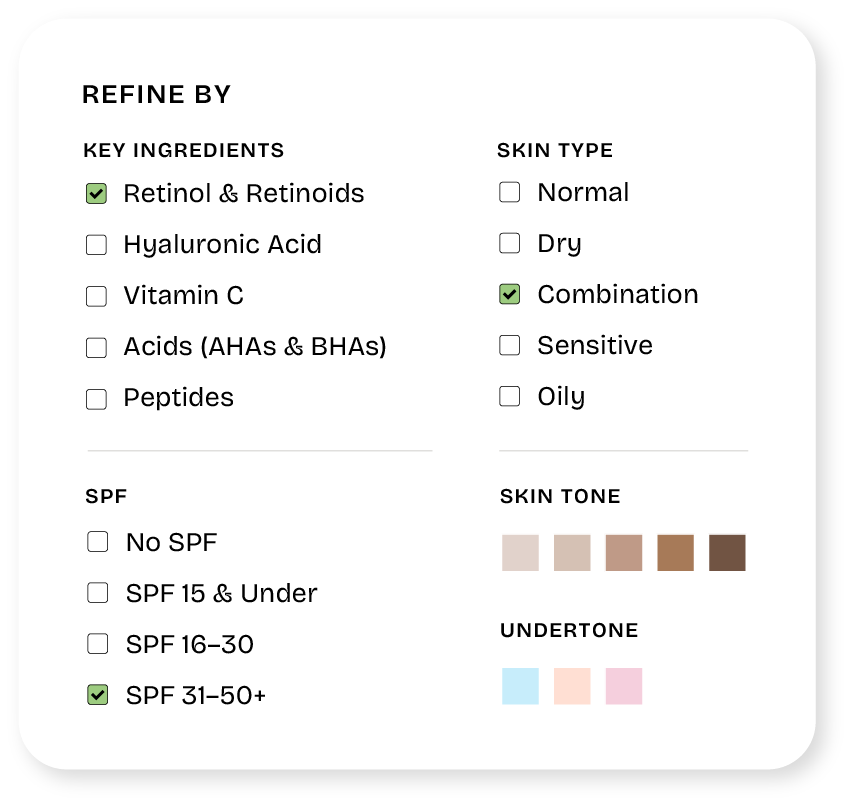
Get the data to create any type of filters customers want.